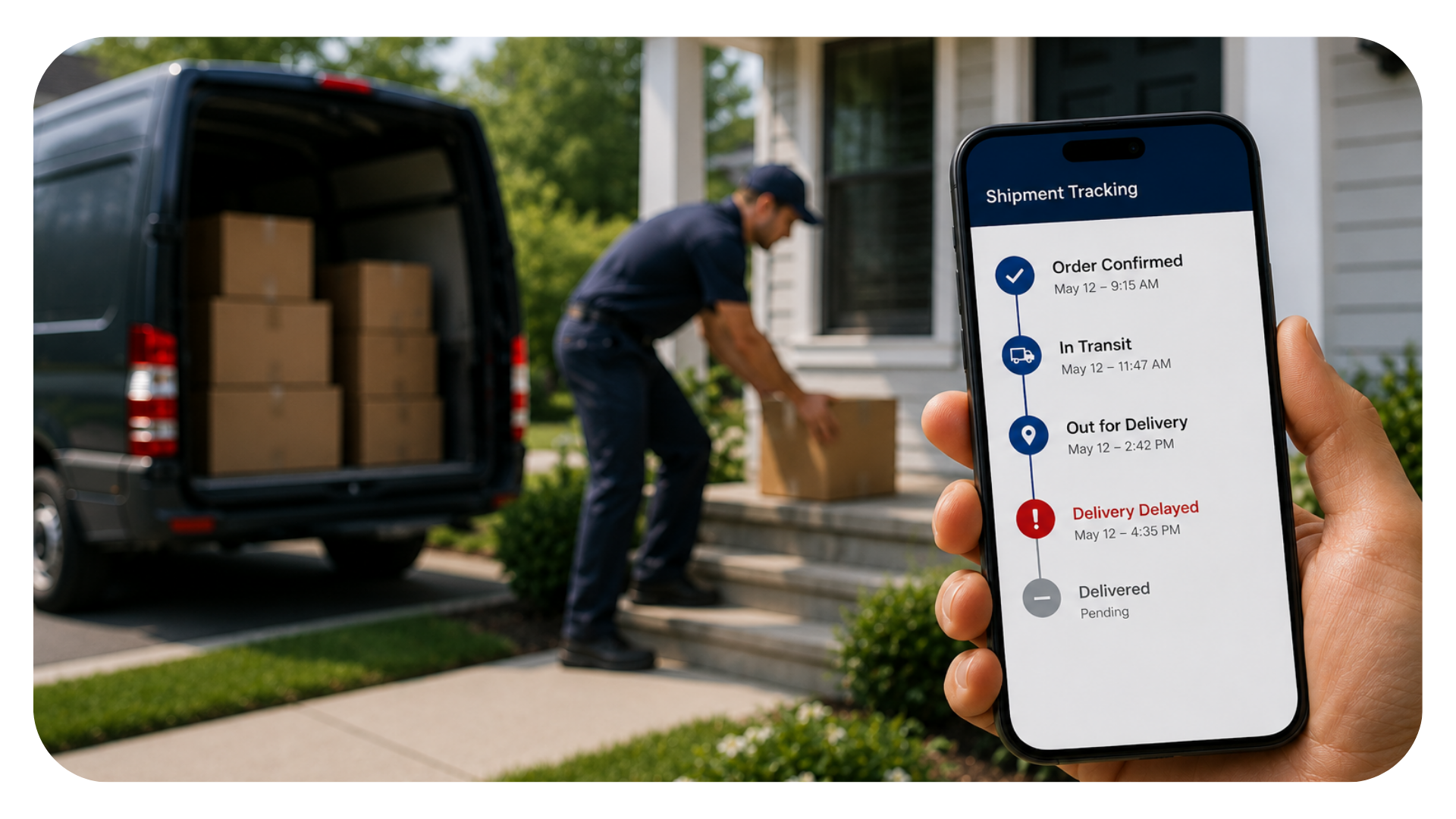
Picture this.
A delivery driver runs up a driveway, tosses a package toward the door, marks it “Delivered,” and drives away. Hours later, the tracking page updates again. Out for delivery. Delayed. Delivered.
Your customer refreshes their screen. The status changes three times in one afternoon. The package never arrives.
It may sound dramatic, but inconsistent tracking is a daily reality for many retailers and fulfillment centers.
This is not just a delivery mistake. It is a breakdown in last-mile logistics.
Behind every inaccurate scan and inconsistent status update is a larger issue that affects margins, operational efficiency, and customer trust.
Modern ecommerce runs on visibility.
Customers expect to know where their order is and when it will arrive. Operations teams depend on the same visibility to manage performance, forecast labor, and maintain service levels.
When tracking data is unreliable, the consequences show up immediately:
Poor parcel tracking creates operational blind spots. Without real-time delivery data, businesses cannot proactively manage delays, reroute shipments, or identify underperforming carriers.
Inconsistent tracking does more than frustrate customers. It damages brand credibility. When delivery promises are unclear, trust erodes.
Reliable parcel visibility is no longer optional. It is foundational to modern last-mile performance.
The parcel delivery landscape has shifted significantly in recent years. New regional carriers enter the market. Capacity changes by season. Service quality varies by geography.
Not every carrier network is built for consistency.
Businesses that rely too heavily on a single carrier or fail to actively manage their carrier mix expose themselves to:
Carrier instability often begins subtly. Exception rates increase. Delivery scans fluctuate. Customer complaints grow.
Over time, those small signals compound into measurable operational and reputational damage.
Carrier selection should never be a static decision. Stability requires strategy.
Transparency is the backbone of reliable last-mile logistics.
Clear pricing protects margins.
Accurate tracking protects customer trust.
Performance reporting protects long-term strategy.
When every shipment is visible across postal, ground, and express services, logistics teams gain control.
They can:
Transparency transforms shipping from a reactive expense into a measurable system.
ShipX embeds transparency into the delivery network itself. Real time tracking, comprehensive reporting, and straightforward pricing eliminate the guesswork that creates operational friction.
No hidden fees.
No blind spots.
No unexpected rate shocks.
Technology alone does not solve last mile complexity.
Managing parcel delivery across all 50 states requires operational expertise, carrier relationships, and continuous performance analysis.
Last-mile optimization involves constant decision-making:
ShipX does not replace major carriers. It helps businesses use them strategically.
Through a multi-carryer delivery model that blends postal, ground, and express services, ShipX selects the optimal path for every shipment based on cost efficiency, transit time, and reliability.
This approach delivers:
Stability in last mile logistics is not accidental. It is engineered through disciplined carrier selection and performance management.
The question is not whether carrier diversification matters.
The question is whether your diversification is intentional.
Unstable tracking and inconsistent delivery performance are symptoms of fragmented logistics planning.
The future of parcel delivery belongs to companies that prioritize:
Shipping smarter means building a parcel delivery strategy that protects both your margins and your reputation.
ShipX is built to power that strategy.
If you are ready to strengthen your last mile logistics with greater transparency, stability, and proven performance, connect with ShipX and take control of your parcel delivery network.

